Vendor-independent · TÜV-certified AI expertise · Working with SMEs since 1995
AI due diligence: decide before you invest
Your desk holds AI ideas, vendor quotes and internal expectations. From the outside it is hard to tell which of them will hold up. We review potential, risks, technology and prerequisites – and give you a clear recommendation: go ahead, go ahead with conditions, or leave it.
When everyone sounds convincing, an independent benchmark is missing.
The business department has discovered a tool. The software house offers an AI module. Another vendor promises a pilot that will supposedly pay for itself within a few months.
All the presentations seem plausible – and all of them come from people who want to sell their solution.
That leaves the decision with you. If you postpone it, your company loses time. If you decide on gut feeling, you risk money, internal capacity and trust in the whole topic.
What is missing now is not another offer. It is an assessment that puts benefits, costs, risks, and feasibility on the same footing.
What we review
Potential
Key question: what measurable benefit can the project deliver?
Result: order of magnitude with assumptions disclosed
Risks
Key question: what can go wrong and what would the consequences be?
Result: prioritised risks and countermeasures
Technology
Key question: does the tool solve the task in everyday work?
Result: verdict on performance, maturity, dependency and alternatives
Readiness
Key question: can your company support the project today?
Result: prerequisites in data, systems, roles and skills
High potential alone is not enough. If reliable data, a usable interface or someone responsible for operation is missing, a good use case still turns into a bad project.
Potential: calculate instead of hoping
We break down the process concerned and check:
How often does it occur?
How much time and money does it cost today?
What proportion can realistically be changed?
What impact on quality, speed, or revenue is plausible?
What internal and ongoing costs offset this?
The result is not an artificially precise figure, but a solid order of magnitude with visible assumptions. This also includes checking whether classic automation would solve the task more cheaply and reliably.
Risks: concrete instead of abstract
We look not only at spectacular scenarios, but at the everyday risks that projects actually fail on:
For each relevant risk we state the consequence, likelihood, possible countermeasure and remaining uncertainty.
Technology: tested on your case
A vendor demo shows what works under ideal conditions.
We are interested in what the tool achieves with your documents, your special cases and your system landscape. Among other things, we check:
Quality of results on representative examples
Interfaces and data access
Permissions and logging
Operating model and running costs
Options to switch and data portability
Realistic alternatives – including the option of doing nothing
Depending on the risk, a compact test is enough or observation in the real workflow is needed. We define the depth of the review before we start.
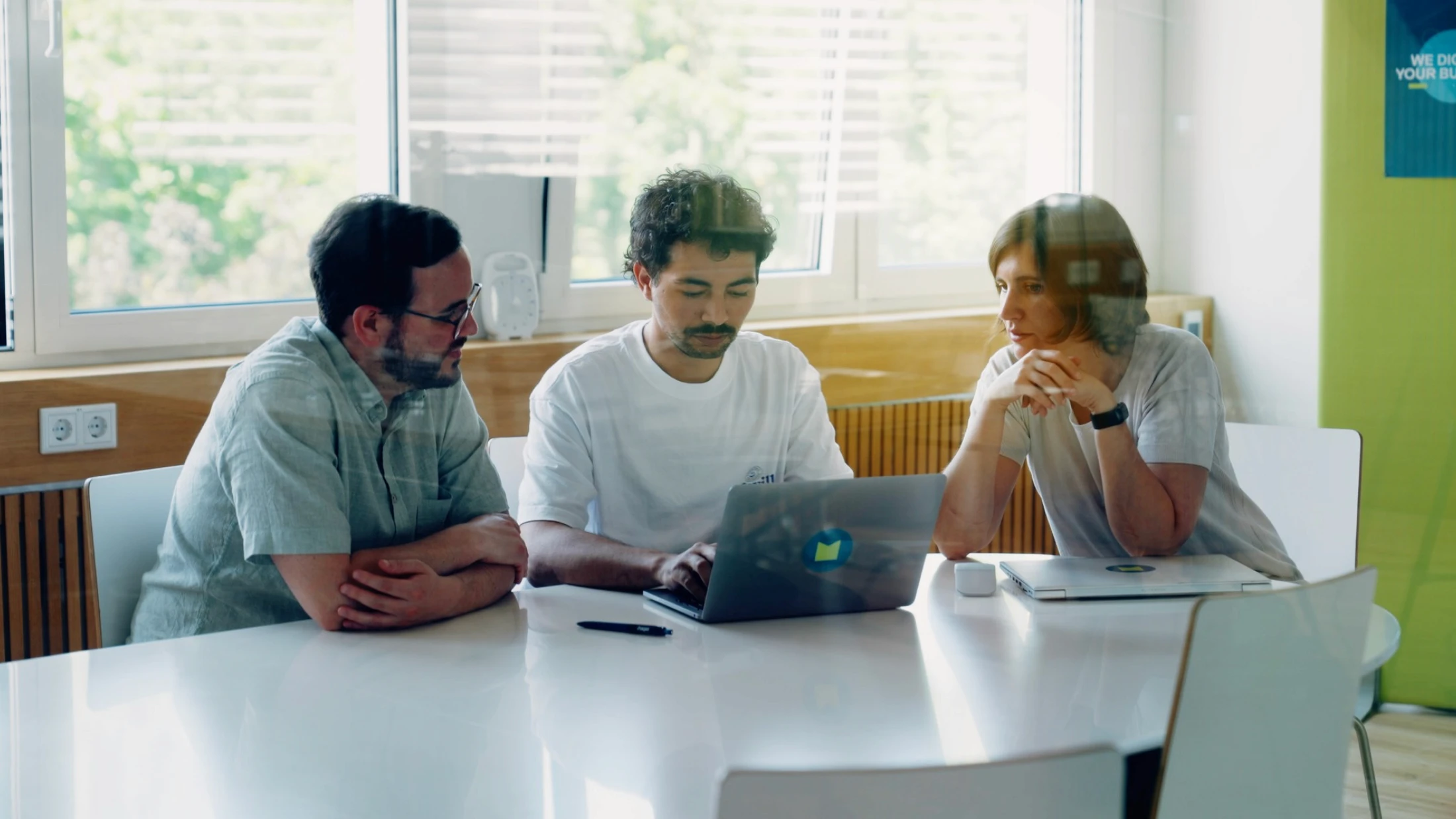
How AI due diligence works
Step 1
Clarify the subject and the decision
We take stock of ideas, quotes and applications already running. Together we define which decision the review is meant to enable.
Step 2
Involve the business department, IT and data
We talk to the people who know the process and check the technical starting point. Existing vendor documents are held up against the reality in the company.
Step 3
Assessment and recommendation
Each project receives one of three verdicts: recommend, recommend with clear conditions, or advise against.
Step 4
Prepare the decision for the management team
We present the result clearly, disclose assumptions and open points and answer the objections of those involved.
Request a free initial consultation
You tell us about the project or quote you need to decide on. We tell you which depth of review makes sense.

What you receive at the end
The document belongs to you and can also be used by your own team or another implementation partner.
" width="17.79995px"><path d="M 8.9 19 L 5.525 20.125 C 5.408 20.158 5.3 20.183 5.2 20.2 C 5.1 20.217 5 20.225 4.9 20.225 C 4.367 20.225 3.9 20.037 3.5 19.662 C 3.1 19.287 2.9 18.808 2.9 18.225 L 2.9 12.775 L 0.3 8.55 C 0.2 8.383 0.125 8.212 0.075 8.037 C 0.025 7.862 0 7.683 0 7.5 C 0 7.317 0.025 7.138 0.075 6.962 C 0.125 6.788 0.2 6.617 0.3 6.45 L 3.7 0.95 C 3.883 0.65 4.125 0.417 4.425 0.25 C 4.725 0.083 5.05 0 5.4 0 L 12.4 0 C 12.75 0 13.075 0.083 13.375 0.25 C 13.675 0.417 13.917 0.65 14.1 0.95 L 17.5 6.45 C 17.6 6.617 17.675 6.788 17.725 6.962 C 17.775 7.138 17.8 7.317 17.8 7.5 C 17.8 7.683 17.775 7.862 17.725 8.037 C 17.675 8.212 17.6 8.383 17.5 8.55 L 14.9 12.775 L 14.9 18.225 C 14.9 18.808 14.7 19.287 14.3 19.662 C 13.9 20.037 13.433 20.225 12.9 20.225 C 12.8 20.225 12.7 20.217 12.6 20.2 C 12.5 20.183 12.392 20.158 12.275 20.125 Z M 8.9 16.9 L 12.9 18.225 L 12.9 15 L 4.9 15 L 4.9 18.225 Z M 5.4 13 L 12.4 13 L 15.8 7.5 L 12.4 2 L 5.4 2 L 2 7.5 Z M 7.85 8.75 L 11.375 5.2 C 11.558 5 11.787 4.904 12.062 4.912 C 12.337 4.921 12.575 5.017 12.775 5.2 C 12.975 5.4 13.079 5.637 13.087 5.912 C 13.096 6.187 13 6.425 12.8 6.625 L 8.55 10.875 C 8.35 11.075 8.117 11.175 7.85 11.175 C 7.583 11.175 7.35 11.075 7.15 10.875 L 5.025 8.75 C 4.825 8.55 4.725 8.312 4.725 8.037 C 4.725 7.762 4.825 7.525 5.025 7.325 C 5.225 7.125 5.462 7.025 5.737 7.025 C 6.012 7.025 6.25 7.125 6.45 7.325 Z" fill="rgb(28, 27, 31)" height="20.22499px" id="WzJjetMdk" width="17.79995px"/></g></svg>)
A management summary with a clear recommendation
The business case with transparent assumptions
A prioritised risk overview including countermeasures
A technical assessment of the tool, vendor, and alternatives
The prerequisites that must be met before starting
A sensible sequence for the next steps
What changes for you
What we don't promise
No legal advice, no audit opinion, no guarantee
AI due diligence is a business, technical and economic assessment. It is not legal advice, not an auditor's opinion and not a guarantee of success. We flag legally relevant points and prepare them so that your legal advisers or data protection officer can take them further.
Uncertain assumptions stay visible
Uncertain assumptions remain visible as such. A review is valuable precisely when it does not claim more certainty than actually exists.
Our X Factor
Independent of vendors
We combine an entrepreneurial perspective, IT strategy and our own implementation experience. Our developers assess interfaces and operation not from a presentation, but from practice. At the same time, we do not sell products from the vendors whose solutions we review and do not receive commissions.
Implementation stays separate
We can take on a later implementation. That decision remains completely separate: our documents are structured so that you can also continue with your team or another partner.

AI Strategy & Application Expert
2026

Funded by BMFTR
2025–2027
brand Award 2026
2026
German Web Awards 2024
2024

Innovative through research
22/23
Frequently asked questions
Can you also just have an existing quote reviewed?
Yes. Then we will focus on benefits, total costs, technical feasibility, contractual and vendor lock-in, as well as realistic alternatives.
Does the review make sense even if no AI is in use yet?
Yes. In that case we look at possible areas of application and prerequisites before a solution has been chosen. That is often the most cost-effective moment.
Does the review help with a project that is already running?
Yes. In this case the decision is usually: continue, improve or stop. Live operation provides better data for this than any demo.
How much does an AI due diligence cost?
The price depends on the number of projects, the areas involved and the technical depth of the assessment. Following the free initial consultation, you will receive a clearly defined scope and a fixed price.
How long does the review take?
A compact assessment can be completed within a few weeks. A test during live operation takes correspondingly longer. We define the timeframe before the engagement.
Is our assessment neutral if we can also handle the implementation?
Yes. Our assessment is based on the actual state of your IT and your business requirements. We document the results in a standalone report that you can use for implementation independently of Moltomedia. If you wish to keep the analysis and implementation organisationally separate, that is not a problem.
What happens to confidential data?
We define in advance which documents and sample data are needed, where they are processed and when they are deleted. Confidentiality and access are agreed before we start.
Review the decision before you start the project
Send us the project, quote or application you are unsure about. In the free initial consultation we clarify whether due diligence makes sense and how deep it should go.